


The Morel Project - Status as of 4 September 2026
What is the overall situation 4 years and 9 months after our website was published?
Since the publication of our website on 3 December 2021, we have continued our morel research at the University of Copenhagen. A very central part of our fine collaboration with the university has continued to be the rental of various facilities, including climate chambers of up to 20 square metres. Furthermore, we are very pleased that Kunststof Holding ApS has continued to cover all expenses related to the project, with Jacob and Karsten Kirk as the company’s only employees. The company has thus provided the overall financing throughout the entire period since September 2008.
Latest developments in the genetic field
Since 2021, we have succeeded in finding and isolating a further 30 genetic variants of the Black Morel (Morchella sp.) from the Danish nature. We subsequently analyzed these variants in various ways, particularly with regard to their ability to develop fruiting bodies in climate chambers using our standard cultivation system. It turned out that 29 of the 30 variants produced first class fruiting bodies in greater or lesser quantities, corresponding to a success rate of 97%. From the time we succeeded in growing the first black morels indoors in 2005 through 2026, we have therefore succeeded in producing fruiting bodies from 102 out of 110 clearly distinct genetic variants of the Black Morel (Morchella sp.) that we ourselves have found and isolated from the Danish nature in Denmark since the spring of 2003. This corresponds to an overall success rate of 93%.
Furthermore, in 2025 we had our 12 most valuable genetic variants DNA-tested by a large biotechnology company in the United States. As expected, all of them proved to belong to the species Morchella importuna. Of these, M. importuna 234 and, in particular, 195 remain by far our most productive variants. Our gene bank, maintained at −196 °C, currently contains precisely these 12 variants, from which material is regularly thawed and used for various purposes.
Since the 12 variants were collected from predominantly very different locations and usually several years apart, and furthermore each variant possesses several highly specific cultivation characteristics, we are convinced that these are in fact 12 completely different genetic variants. However, in order to be 100% certain, we had the aforementioned American company carry out a DNA analysis capable of determining with 100% certainty whether our assumptions are correct.
Development and test of a completely new and apparently groundbreaking product for our morel soil
Since 2021, we have worked intensively to further optimise our cultivation method in various ways. Of particular importance has been the development of a completely new and apparently groundbreaking product for our morel soil, which has significantly stabilised and increased morel yields while also improving the quality of the harvested mushrooms. It therefore appears that, in addition to containing chemical activating substances, the product also has a markedly positive influence on the balance between beneficial and harmful microorganisms for the morel mycelium in the well defined soil.
High and stable product quality is crucial for success
Over the years, we have learned that both high and stable morel yields can only be achieved if all products used in the cultivation process are of absolutely top quality. If even one of the products used is of inferior quality, there is a risk that the particular morel production will fail either completely or partially. It is therefore essential that all products meet the following requirements:
- The product must always be manufactured and handled in exactly the same way from batch to batch by the manufacturer and supplier.
- Wherever possible, the product should always be purchased from the same reliable source.
- The expiry date must never be exceeded. Furthermore, it is absolutely essential that the product is continuously stored under optimal conditions prior to use.
In conclusion, we are pleased to be able to state that we have gained control over the entire area concerning product safety in connection with intensive cultivation of morels under controlled conditions.
Record yields achieved during the period 2021-2026
Following the introduction of a new strategy for adding the nutrient source to a given pallet cultivation system with an area of 0.87 m², we achieved a record yield of Morchella importuna 234 in January 2023 of 4.9 kg, corresponding to 5.6 kg of morels per m². The previous record for this variant of 3.2 kg of morels per m² was thus convincingly surpassed.
The record yield of Morchella importuna 234 achieved in January 2023, corresponding to 5.6 kg of morels per m².
Primarily as a result of the development of the aforementioned apparently groundbreaking product for our morel soil, we also achieved a record yield of Morchella importuna 195 in April 2026 in one of our pallet cultivation systems of 6.8 kg, corresponding to 7.8 kg of morels per m². The previous record for this variant of 4.2 kg of morels per m² was therefore also substantially improved. It was furthermore remarkable that the latest record was based on an outstanding quality of both large and beautiful morels, which were very easy to harvest. Within one week, we harvested all 281 morels from the pallet cultivation system, with an average weight of approximately 24 g.
As the total cultivation period was 24 weeks, this corresponds to 16.9 kg of morels per m² per year. It is very important to emphasise here that, just as with M. importuna 234, these morels taste exactly as good as the finest morels harvested in the wild, but without the presence of various impurities such as grit, small animals, etc.
Following the completion of the latest trial in April 2026, we can state that we have harvested a total of 234 kg of morels, primarily in our largest climate chamber of 20 m², since we first succeeded in producing morels indoors in 2005.
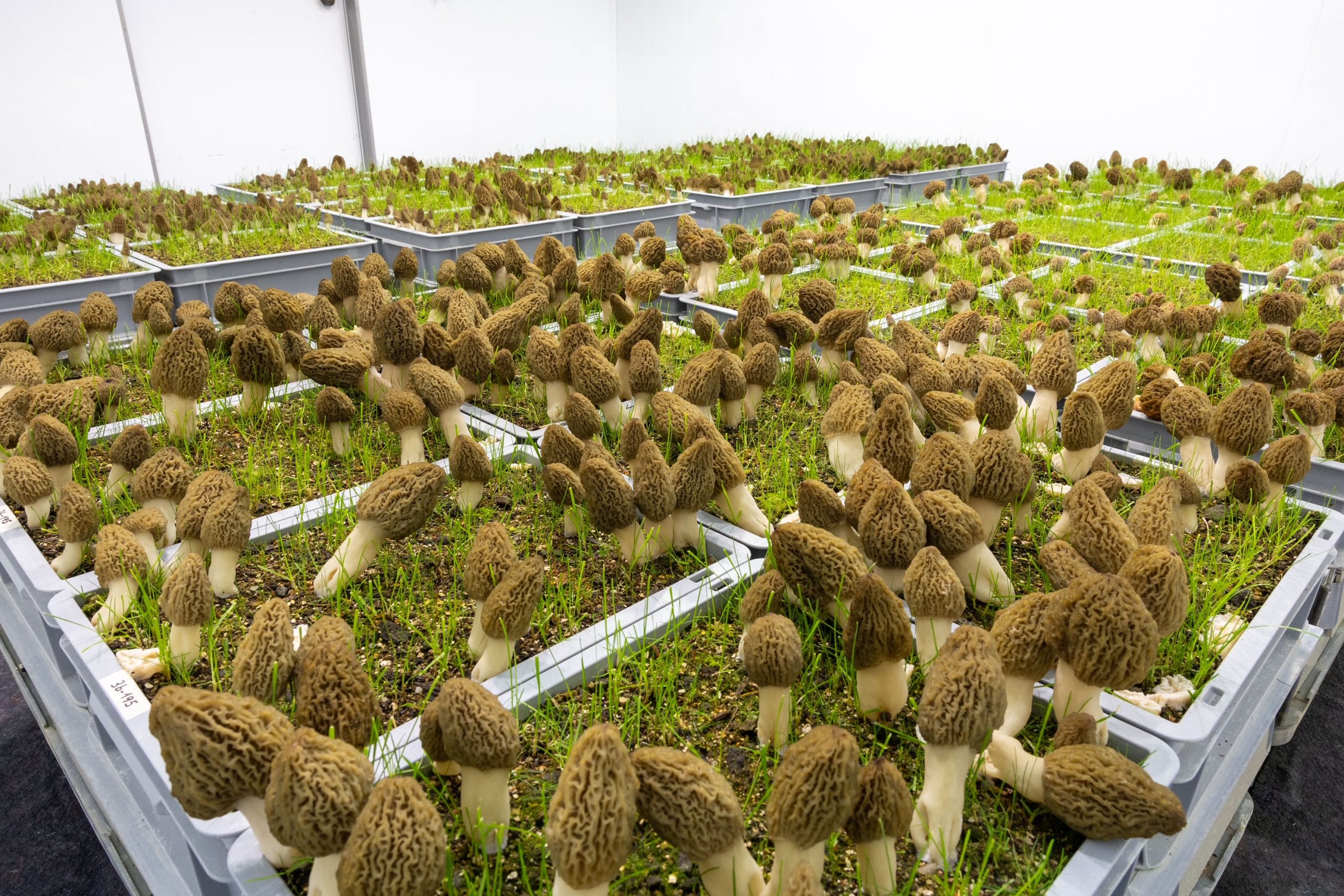
Our two most valuable variants, Morchella importuna 195 and 234, in the cultivation beds in April 2026. In the background, numerous young fruiting bodies of 234 can be seen developing.
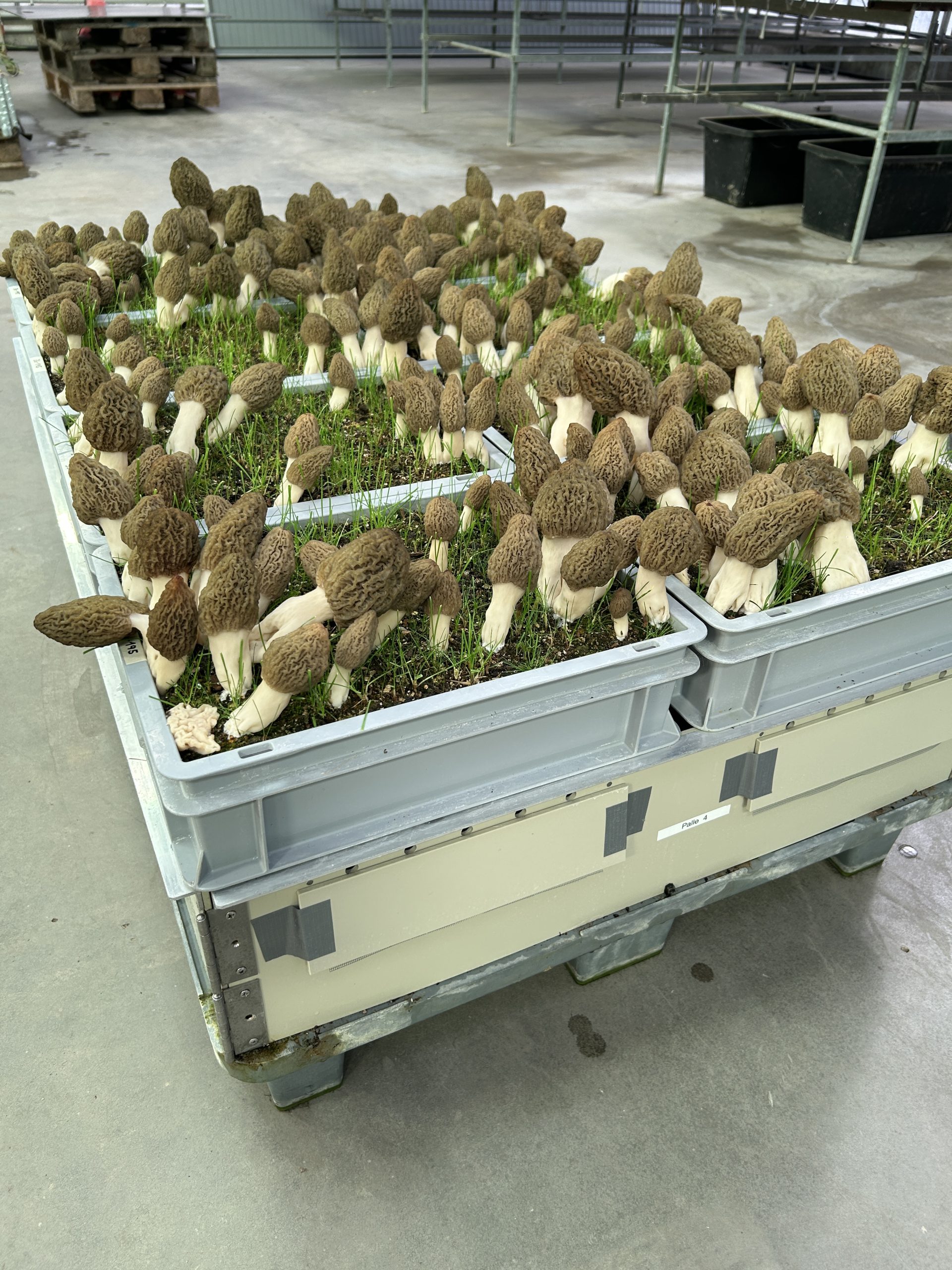
The record yield of Morchella importuna 195 achieved in April 2026, corresponding to 7.8 kg of morels per m².
The record yield of Morchella importuna 195 achieved in April 2026. Within one week, we harvested all 281 morels from the pallet cultivation system, with an average weight of approximately 24 g.
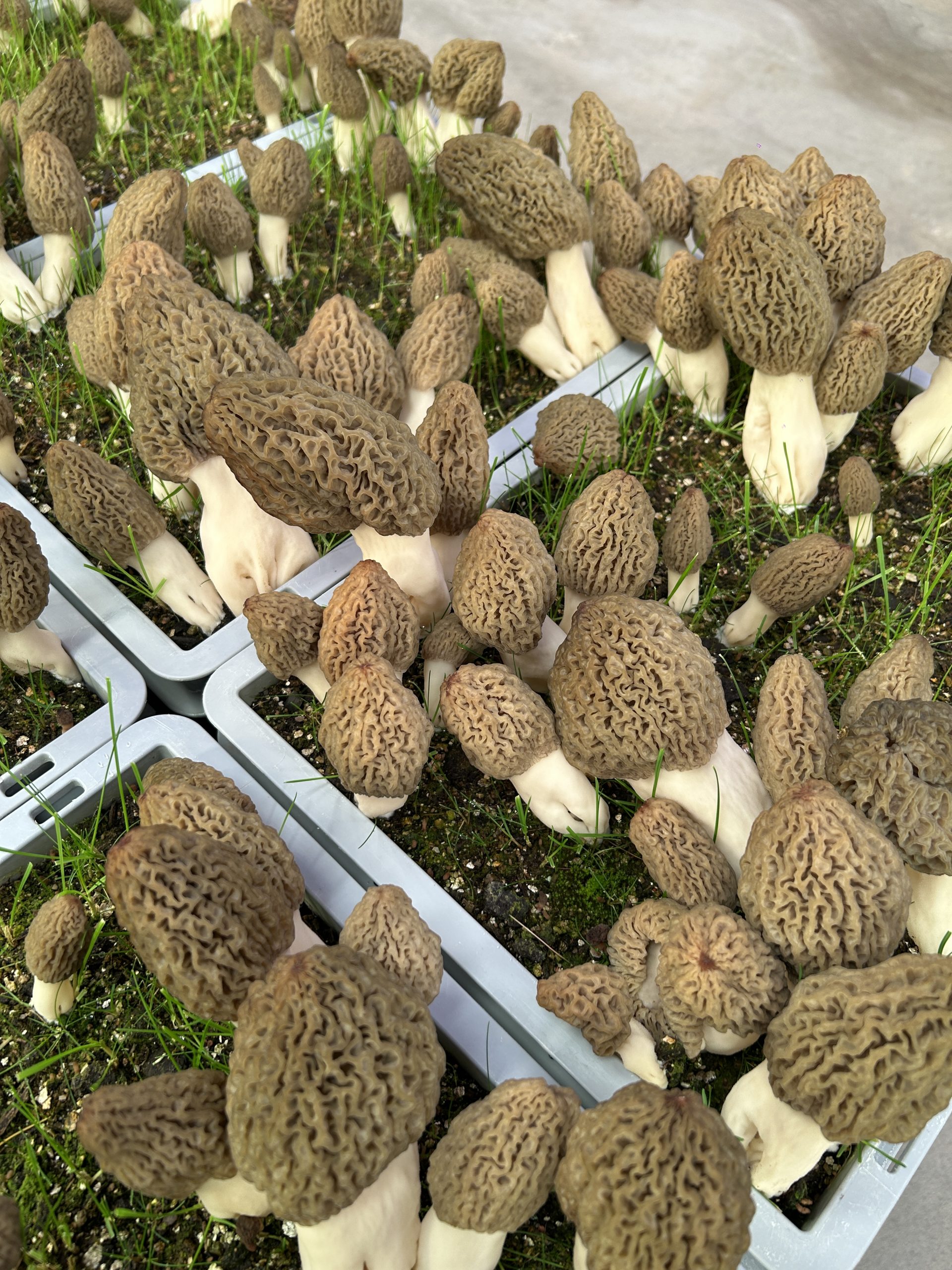
The record yield of Morchella importuna 195 achieved in April 2026. Note the quality of the large and beautiful morels, which were very easy to harvest.